

How To Check Usb Ports On Windows 7
Afterwards some deep investigation, Greg Shultz came across a Windows seven uniform version of the old Windows utility USB View.
 I recently constitute myself on a USB troubleshooting trek and needed to be able to get a visual image of what device was connected to what USB hub number and port number. I started out by looking at the concrete USB ports on the figurer and following the cables to the continued device just to get a general overview. With that picture in listen, I was sure that Device Managing director would help me pull it all together. Unfortunately, that wasn't the case.
I then remembered seeing USB port information in Windows seven's Devices and Printers tool. And while this tool does provide a peachy fashion to identify USB details for the devices connected to a PC and allowed me to specifically identify what device was connected to what port, I all the same wanted more detailed information about all the USB connections inside the PC.
Amend tool
I was certain in that location had to be a better tool out at that place and started looking into Microsoft's Windows Sysinternals site, but I didn't immediately see anything that specifically mentioned USB. Nonetheless, while I was looking through the list of utilities on the Sysinternals site, I recalled a Windows 98 Resource Kit utility chosen USB Viewer and wondered if Microsoft had e'er updated that tool. So I typed USB Viewer in the Bing box and clicked the Search push button.
While I did find a link to an one-time document concerning the Windows 98 USB Viewer utility, I also found a mention of a newer version for Windows XP called USB View. Searching for USB View turned up a discussion in the Windows 7 Hardware Compatibility TechNet forum where someone suggested using Microsoft's USB View equally a troubleshooting help for USB bug in Windows 7. The post likewise provided a link to download USB View from the Hereafter Engineering science Devices International Web site.
Now, I've never heard of that visitor earlier, and and so I was a little leery. Further excavation on Microsoft'south Web site turned up a detailed description of USB View on MSDN, but it allowed me only to download the C++ code. With this verification that Microsoft had indeed developed a utility by that name, I threw circumspection to the wind and downloaded USB View utility from the Future Technology Devices International Spider web site. (Information technology turns out that Future Technology Devices International specializes in USB device solutions and took the time to compile the C++ code and brand the USB View executable available for download.) The utility works great in Windows 7 and forth with the information from Device Director and Devices and Printers I was able to compile all the pieces and pull together the picture I needed of my arrangement's USB configuration.
In this edition of the Windows Desktop Study, I'll show you how to employ the USB View utility along with Device Manager and Devices and Printers to map out the USB ports on your PC.
Device Manager
When you lot access Device Manager and expand the Universal Serial Omnibus Controllers co-operative, you see the USB Host Controllers and the USB Root Hubs. I disconnected all the USB devices on my test system to go downwards to the basics. I and then brought upward the Backdrop of the USB Host Controllers and the USB Root Hubs and checked the Location. Figure A shows the Location details provided by Device Director for the Standard Enhanced PCI to USB Host Controller, which is the driver for the USB 2.0 ports in my exam system. The Standard OpenHCD USB Host Controller represents the USB 1.0 driver that Windows 7 makes bachelor for backward compatibility.
Figure A
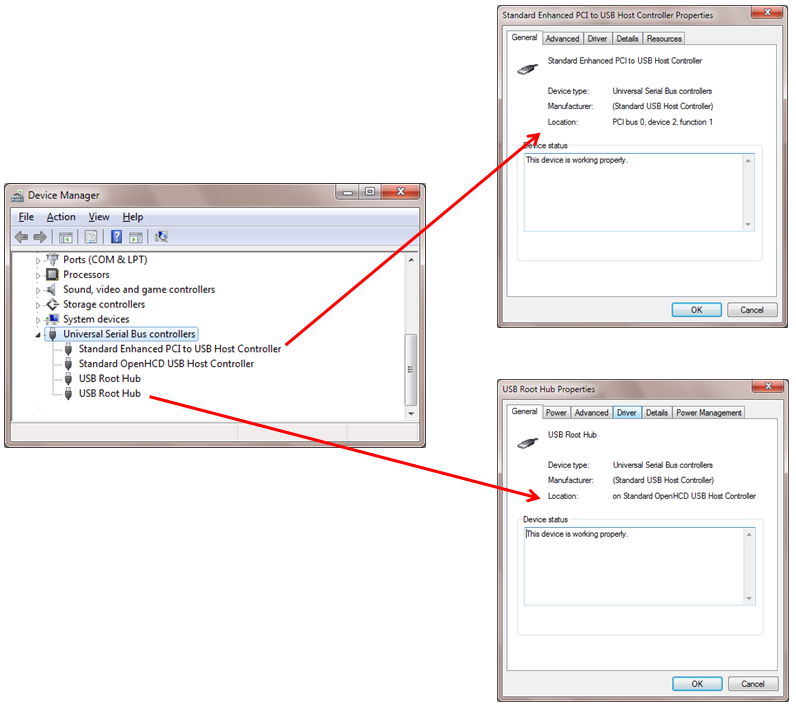
I asunder all the USB devices on my test system to go down to the nuts.
I reconnected the ii external USB Hubs and all the other USB devices and returned to Device Manager. I and so accessed the Properties of those devices and checked the Location, as shown in Figure B. However, I however couldn't go a direct correlation as to what was continued where.
Figure B
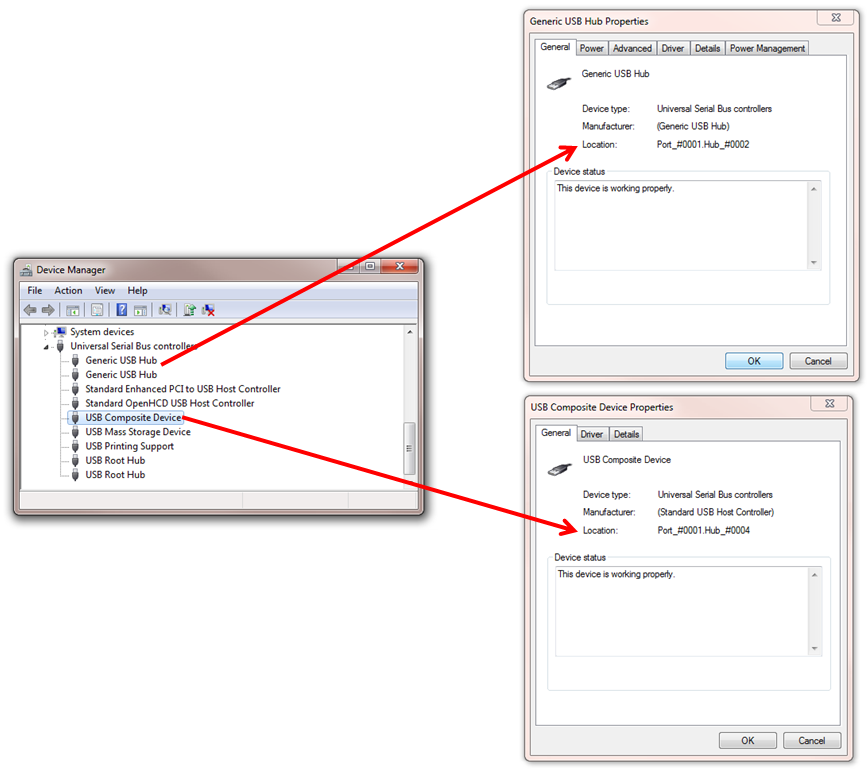
While Device Manager lists all the continued USB devices, it is withal difficult to tell how the devices are connected to the organisation.
Devices and Printers
Devices and Printers is designed to allow you to hands see what devices are continued to your system. It volition also allow you to run into how devices are continued to your organization. If y'all access a device's Properties and so select the Hardware tab yous can find Location information, as shown in Figure C. While starting with an image of the actual device makes it a bit easier to tell what y'all are working with, the Location information is vague and I yet couldn't get the connection movie that I was after.
Effigy C
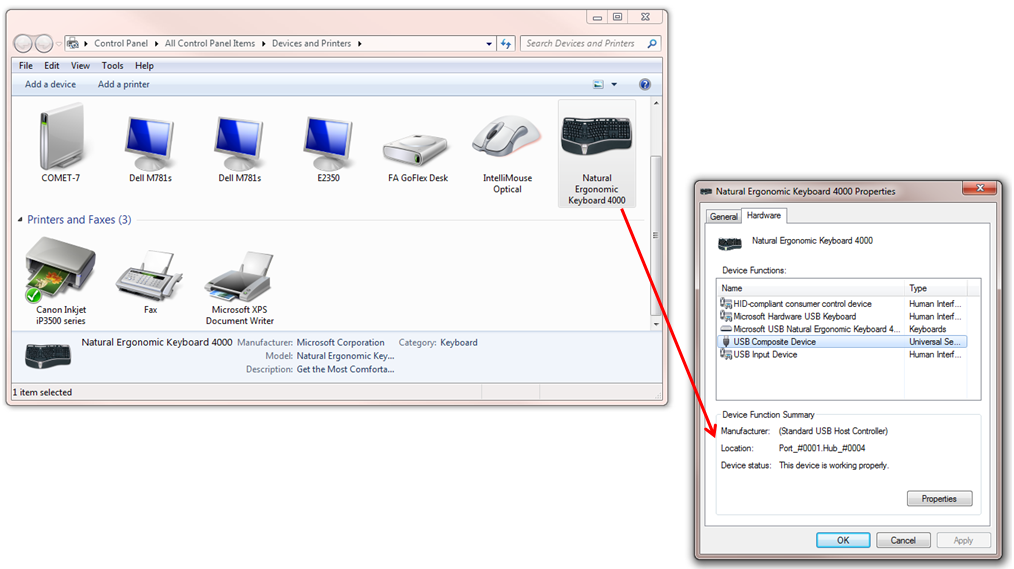
Devices and Printers tin can also provide Location data for USB devices.
USB View
When I finally tracked downwards USB View, I discovered that you tin can run it right away every bit in that location is no installation procedure. Keep in mind that you have to get through Open File Security Warning dialog box starting time. Equally presently as yous do, the programme scans your USB connections and populates its window with a tree view and all the connection details that I was looking for.
For example, looking at the USB View screen shown in Figure D, I tin immediately tell that my case organization is equipped with 8 USB ports. I as well see that the Microsoft Keyboard is continued to Port one of a 4-port USB hub that is connected to Port 2 on the calculator. I can besides tell that the 4-port USB hub is a USB 1.0 device because it is showing upwardly under the Standard OpenHCD USB Host Controller.
Figure D
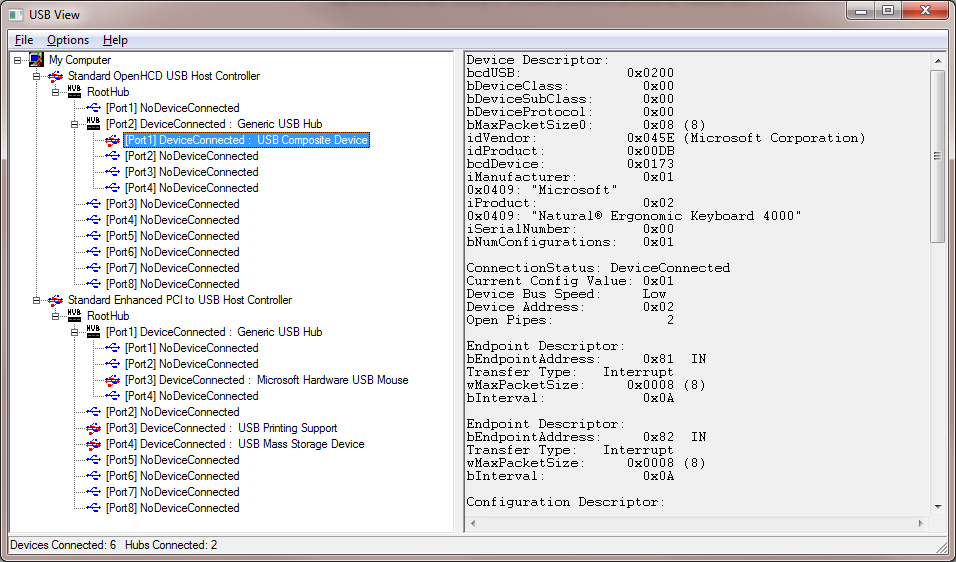
Microsoft USB View makes it extremely easy to get a complete movie of the USB connections on your organisation.
I can tell that the Microsoft Mouse is continued to Port 3 of a 4 Port USB hub that is connected to Port one on the computer. I can also tell that this 4-port USB hub is a USB two.0 device because information technology is showing up under the Standard Enhanced PCI to USB Host Controller. The tree also shows that the printer is connected to Port 3 on the computer and that the external hard bulldoze is connected to Port 4 on the calculator.
As you tin see, USB View makes it extremely easy to get a consummate moving picture of the USB connections on your system.
What your take?
At present that you know about USB View are you likely to download and use it? Every bit always, if you lot have comments or data to share about this topic, please take a moment to drib by the TechRepublic Community Forums and allow us hear from you.
Also read:
- Apply a USB Flash Bulldoze to Create Windows Password Reset Disk in Windows 7
- 10 Things Y'all Should Know about USB 2.0 and 3.0
- Configure a USB Flash Bulldoze to Be a Windows 7 Installation Platform
Source: https://www.techrepublic.com/article/map-and-troubleshoot-your-usb-ports-with-microsoft-usb-view/
Posted by: herrodpasm1975.blogspot.com
0 Response to "How To Check Usb Ports On Windows 7"
Post a Comment